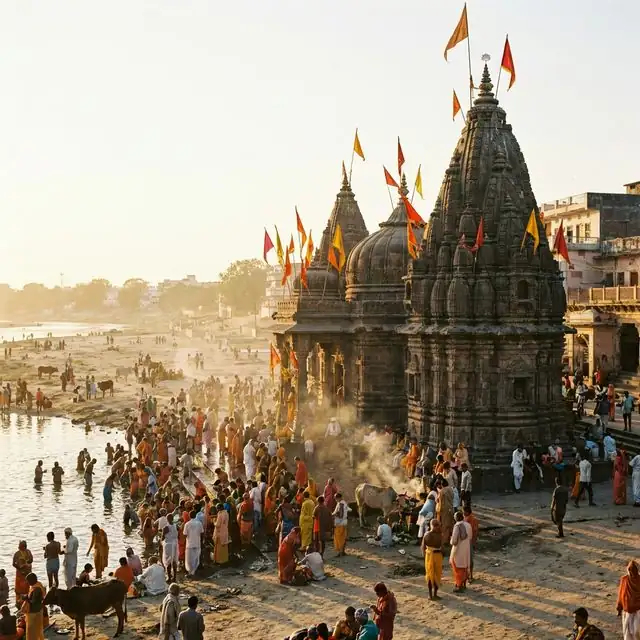
Pind Daan at Gaya
Honour Those Who Came Before — at the Only Place in India Where the Ritual Frees an Entire Lineage
A complete, hereditary-pandit-led pilgrimage. Performed in Sanskrit. Translated and explained in English. Held with the absolute gravity it deserves.
Direct Hereditary Gayawal Pandits
Administered by authentic, unbroken 1,200-year priestly lineages. Your family's traditional offerings are recorded in ancient, hand-written ancestral ledgers (Bahi Khata) for absolute, verified lineage purnata.
Lineage Efficacy
Whole-Lineage Purnata (Paternal & Maternal)
Priesthood Authority
Hereditary Gayawal Pandits (1,200 Yrs Legacy)
Core Topography
Vishnupad Basalt footprint & Akshayavat Banyan
Prime Season
Pitru Paksha (Sep 26 – Oct 10, 2026)
In Hindu tradition, no soul is forgotten — but in one city, alone in all of India, every soul of an entire lineage can be liberated in a single ceremony. That city is Gaya. The boon was granted by Vishnu himself. The ritual has been performed without pause for three thousand years. We exist to make sure it is performed correctly — for you, for your family, for the ones who waited.
Sacred Primer
Understanding Pind Daan
“A complete, hereditary-pandit-led pilgrimage covering the principal vedis.”
Pind Daan is the Hindu ritual through which a living family honours its deceased ancestors. Through the offering of rice-balls (pinda), water (tarpan), and Sanskrit mantras conducted by a qualified priest, the soul of the departed is believed to be released from the cycle of rebirth and granted moksha — liberation. It is one of the most important duties a Hindu family member can fulfill, and a ritual the Garuda Purana identifies as essential for the peace of every soul.
Gaya is unique among India's sacred cities because the ritual performed here, by tradition, liberates the entire ancestral lineage in a single ceremony — parents, grandparents, great-grandparents, ancestors going back generations, and even those whose names have been lost to time. The boon, according to the Vayu Purana, was granted to the demon Gayasura by Vishnu himself. There are forty-eight sacred ritual spots (vedis) across the city; the traditional rite covers seventeen of them, conducted by hereditary priest families called Gayawal Pandits who have administered these rituals in unbroken succession for over 1,200 years.
Pitru Paksha — the sixteen-day "fortnight of the ancestors" that falls each year in September or October — is the most spiritually charged window for performing Pind Daan. In 2026, Pitru Paksha falls between approximately 26 September and 10 October. Performing Pind Daan during this window is considered the highest possible form of the ritual.
The Sacred Gaya Axis
Hover or tap the key ritual spots (vedis) across the sacred geographical timeline to preview where your offerings will be presented.
Vishnupad Temple (Vedi of the Footprint)
Worshipped for millennia, this beautiful basalt shrine houses the 40-cm footprint of Lord Vishnu pressed into solid rock. Here, the primary pinda offering is made to the core lineage directly, inside a structure rebuilt in 1787 by the legendary queen Ahilyabai Holkar of Indore.
Why Gaya, and Why During Pitru Paksha
The Only Place in India for Whole-Lineage Liberation
At Gaya, a single ceremony can honour every ancestor in your lineage — known and unknown, named and forgotten. No other city in Hindu tradition holds this absolute boon.
1,200 Years of Unbroken Hereditary Priesthood
The Gayawal Pandits who perform the ritual are not contracted priests. They are hereditary lineages whose right and responsibility to conduct Pind Daan was established over twelve centuries ago. The mantras remain unchanged.
Vishnu's Footprint at Vishnupad
The 40-cm footprint of Lord Vishnu, pressed into solid rock, presides over the central ceremony. The temple — rebuilt in 1787 by the great Maratha queen Ahilyabai Holkar of Indore — stands on a site worshipped continuously since the 6th century BCE.
Pitru Paksha — The Window When Ancestors Listen Closest
For sixteen days each September, Hindu tradition holds that the souls of the departed are closest to the physical plane. Performing Pind Daan in this window carries the absolute peak of spiritual weight.
Choose the Path That Fits Your Family
We have structured four distinct offerings, each suited to a different need and time commitment. Conducted by a senior Gayawal Pandit with full Sanskrit ritual integrity.
Offering II: Tarpan Yatra
“The most-chosen offering — a complete three-day Pind Daan covering the principal vedis.”
Time Commitment
3 days / 2 nights
Sacred Sites Covered
Falgu River, Vishnupad Temple, Pretshila Hill, Akshayavat, Brahma Kund — covering the major vedis of the traditional rite
Lineage Ancestors Honoured
Direct parents, grandparents, great-grandparents, maternal lineage, paternal lineage
Assigned Ritual Priest
Senior Gayawal Pandit + assistant pandit
Lineage Care & Logistical Inclusions
All of the above + 2 nights' accommodation in Bodh Gaya at our partner property; private chauffeured transport; vegetarian satvik meals; English commentary throughout; daily debrief with your scholar-companion
The Experience Flow
A Sample Three-Day Journey
Arrival & Sankalp
Airport pickup at Gaya International Airport (IXW) or Patna Airport (PAT). Welcome at our partner hotel in Bodh Gaya — 15 minutes from Gaya, but offering significantly superior comfort, air quality, and peace.
Quiet rest. Late-afternoon meeting with your Gayawal Pandit at the hotel — a 60-minute grounding conversation in which the Pandit gathers your gotra, ancestral details, and family lineage information, and prepares the sankalp (formal intention) for the ritual. This conversation is, for many, the moment when the journey becomes real.
Light satvik dinner. Early sleep — the next morning begins before dawn.
The Core Ritual
Wake. Light fruit and warm water.
Drive to Falgu River as the sky begins to lighten.
First ritual at the Falgu — the sand-pit water ritual, where you dig your own small pit and find the river that flows beneath. Tarpan offering with sesame, water, and barley grains. Your Pandit recites the opening Sanskrit mantras; our scholar-companion translates each line so you understand what is being said in your name.
Breakfast at a heritage Bihari restaurant — sattu paratha, kachori, fresh chai.
Vishnupad Temple — private darshan of the 40-cm Vishnu footprint. The Pandit performs the main pinda offering at the Garbha Griha and explains the seventeen vedis tradition.
Vegetarian satvik lunch. Quiet hour for reflection.
Pretshila Hill — the "Hill of the Departed Souls." The second-most-important vedi, where rituals are specifically performed for those whose deaths were sudden, violent, or unfulfilled.
Return to Bodh Gaya. Time alone.
Quiet dinner. Many travelers describe Day 2 as the most emotionally heavy day of their lives. We hold space for that.
Completion & Reflection
Final ritual at Akshayavat — the imperishable banyan tree — where the poornahuti (completion offering) is made. The Pandit declares the rite complete with the closing blessings.
Breakfast.
A quiet morning at Mahabodhi Temple in Bodh Gaya — 15 minutes from the hotel. This is included not as tourism, but as integration — many travelers find that sitting under the Bodhi Tree for an hour after completing Pind Daan provides a quietness that nothing else does.
Farewell lunch with your Pandit. He blesses your family and your onward journey.
Airport drop. Departure.
For NRI and Diaspora Travelers
“Will the ritual feel authentic, or simplified for foreigners?”
The ritual is performed in full Sanskrit by hereditary Pandits whose families have administered Pind Daan at Gaya for over 1,200 years. We do not adapt the mantras. We do not shorten the sequence. The only addition — and only if you request it — is English translation layer alongside, spoken by our scholar-companion in a low voice between the Pandit's recitations, so that you, your spouse, and your children understand the deep meaning of what is being offered in your name.
“My parents are elderly — can they manage three full days?”
Yes. The majority of our Pind Daan travelers are 60+. We design specifically for this comfort:
- Minimal walking; palanquins arranged
- Soft satvik & satvik meals
- Hotels selected for proximity & comfort
- Doctor-on-call 24/7 & Oxygen support
“My children are American — they don't speak Hindi or Sanskrit.”
This is the most common concern NRI families share with us. Our solution: the English-translation layer. Your Pandit performs the ritual in full Sanskrit. Our scholar-companion sits beside you and quietly translates each invocation, each offering, each meaning. By the end of Day 2, most children — and many adults — find themselves understanding not just the words but the profound worldview behind them. Several of our travelers' young-adult children have told us, afterwards, that this trip was the first time they understood why their parents had asked for this. That is a quiet miracle.
“Do I need to bring anything from home?”
You may, if you wish, bring:
- ✦Ashes (asthi) of recently departed family members, if not yet immersed — we coordinate with Varanasi or local Gaya immersion options.
- ✦A photograph of the ancestor(s) you wish to honour — many travelers place it beside the pinda during the ritual.
- ✦An object that belonged to your departed (a small piece of jewellery, a fountain pen, a fragment of cloth) — for personal placement during the ritual.
- ✦A family genealogy document, if you have one, to help the Pandit speak the ancestral names with historical accuracy.
* You do not need to bring ritual materials. We provide every single item required, sourced fresh on the morning of the ritual.
“Will I be allowed into Vishnupad Temple as a non-Hindu or as a foreign-passport holder?”
Vishnupad Temple has historically had restrictions on non-Hindu entry to the inner sanctum. We coordinate with the Pandit hierarchy in advance for our travelers. For practising Hindus of any nationality (including foreign-passport-holding NRIs), entry is arranged. For non-Hindu spouses, partners, or family members, we arrange respectful participation in the outer rituals at the Falgu, Pretshila, and Akshayavat — which carry full spiritual weight in their own right.
Key Dates — Pitru Paksha 2026
| Phase | Approximate Dates 2026 |
|---|---|
| Pitru Paksha begins (Pratipada) | 26 September 2026 |
| Mahalaya Amavasya (The most powerful day) | 10 October 2026 |
| Pitru Paksha ends | 10 October 2026 |
| Auspicious sub-windows | We will share specific tithis favourable to your gotra in our proposal |
Booking lead time: During Pitru Paksha, demand for senior Gayawal Pandits exceeds capacity by approximately 4×. We recommend booking 60–90 days in advance. Final bookings for September 2026 close around mid-July 2026.
Six Commitments That Make Us Different
How we distinguish our curated pilgrimages from local commercial Gaya tour operators.
Hereditary Pandit Network — Not Contract Priests
We work exclusively with senior Gayawal Pandits whose families have held the right to perform Pind Daan at Gaya for over 1,200 years. We name your Pandit in your proposal. You will meet them before the ritual.
Transparent, Itemised Pricing
Every rupee in our quote is accounted for: Pandit honorarium, ritual materials, temple offerings, transport, accommodation, taxes. We do not work with commission-based pandit "agents" who upsell during the ritual. Beware of operators who quote suspiciously low — Pind Daan that costs too little is rarely complete.
English-Language Scholar Companion
A scholar of Sanskrit and Hindu ritual studies accompanies you throughout — translating, contextualising, answering questions, and ensuring you understand the meaning of what is being offered in your name.
Premium Accommodation in Bodh Gaya
Gaya itself has limited luxury accommodation. We base our travelers in Bodh Gaya, 15 minutes away, at properties chosen for cleanliness, comfort, and quietness — so the emotional weight of the ritual is held in a setting that supports you.
Multi-Generational Care
Soft meals for the elderly. Translation for the young. Mobility support for those who need it. Doctor-on-call 24/7. Vegetarian, satvik, Jain-friendly, or Vaishnav-compliant cuisine throughout.
Post-Ritual Integration
We include a final morning at Mahabodhi for travelers who wish it — not as tourism, but as a quiet, supported space for emotional integration after a profoundly heavy ceremony. Many travelers tell us this is the most important hour of the trip.
Frequently Asked Questions
Tradition holds that a complete Pind Daan at Gaya, performed correctly even once, fulfills the duty for the entire lineage. Many families choose to return periodically to honour specific deaths in the family. Some return annually during Pitru Paksha as an ongoing practice. There is no rule — only what feels right to you and your family.
Yes. The Garuda Purana itself recognises the right of daughters, wives, and sons' wives to perform Pind Daan for their ancestors. While historical practice in some regions limited the ritual to male descendants, the Gayawal Pandits we work with explicitly perform Pind Daan for and with women — including daughters performing for parents in the absence of a son. This is increasingly the norm at Gaya.
Pind Daan can be performed at many sacred sites — Haridwar, Allahabad (Prayagraj), Varanasi, Rameswaram, and others. Only at Gaya does the ritual carry the boon, by tradition, of liberating the entire ancestral lineage in a single ceremony. The reason families travel here is precisely this completeness.
The mantras are in Sanskrit — the ritual language of Hindu liturgy, unchanged for millennia. Communication with you, your Pandit, and your scholar-companion happens in Hindi or English (your preference). Translation of mantras into English is provided alongside if you wish.
For the rituals, traditional Indian dress is required: men in dhoti or pyjama-kurta (we can arrange these on-site); women in saree, salwar-kameez, or other traditional Indian attire with shoulders and knees covered. No leather (belts, watch straps, wallets) inside the Vishnupad inner sanctum. We send a complete pre-arrival packing list with your booking confirmation.
Yes — with full respect for the ritual's integrity. Non-Hindu companions can participate meaningfully in the outer rituals at the Falgu, Pretshila, and Akshayavat. For the Vishnupad inner sanctum, we coordinate respectful arrangements case-by-case.
We are gentle witnesses to this. Many families come with different views — about whether to include certain ancestors, about which gotra to invoke, about whether to perform a 3-day or 7-day rite. Our scholar-companion can help mediate. Our Pandit can offer wisdom. But the decisions are yours, and we hold space for the conversation without judgment.
Every Pandit we work with is a hereditary Gayawal Pandit with documented lineage — verifiable through the Gayawal Pandit registry maintained at Gaya. We name your Pandit in advance. You meet them before the ritual. They speak respectfully, charge transparently, and never pressure you for additional offerings during the ceremony.
We know this is not a regular booking decision.
Pind Daan is one of the most spiritually weighty acts a Hindu can perform on behalf of their family. The questions you may want to ask — about your specific ancestor, your gotra, your family's regional tradition, your elderly parent's health, your child's discomfort with ritual, your own readiness — are best answered in conversation, not via a cold text form.
Before you commit to anything, we invite you to a complimentary 30-minute call with our Pind Daan specialist or Co-Founder. They are deeply familiar with the Gaya tradition and personally consult on every Pind Daan booking we accept.
There is no obligation. We will help you understand the ritual, discuss your family's specific needs, and only then — if it feels right — share a proposal.
Ready to Honour Those Who Came Before?
Pitru Paksha 2026 begins on 26 September. Dates fill quickly. Senior Gayawal Pandits are limited. We accept fewer than 30 Pind Daan bookings per Pitru Paksha to ensure each family receives the absolute depth of care this ritual requires.
A Closing Note
In every Hindu household, there is a small altar to those who came before us. A photograph. A small brass lamp. A name spoken with reverence on certain quiet mornings. Pind Daan, at Gaya, is the moment when that small home altar is brought to its largest possible cosmic setting — the city Vishnu blessed, the river Sita cursed, the banyan tree that survives all ages.
We do not promise that this journey will erase grief. We do not promise that you will return unchanged. We promise only this: that the ritual will be performed correctly, in the place tradition has reserved for it, by hands that have held it for over a thousand years. The rest — the meaning, the release, the quietude — those belong to you and to those who have been waiting.
We would be deeply honoured to walk this with you.
— Himanshu Kumar & Nishant Ojha
Co-Founders, Roots & Rounds