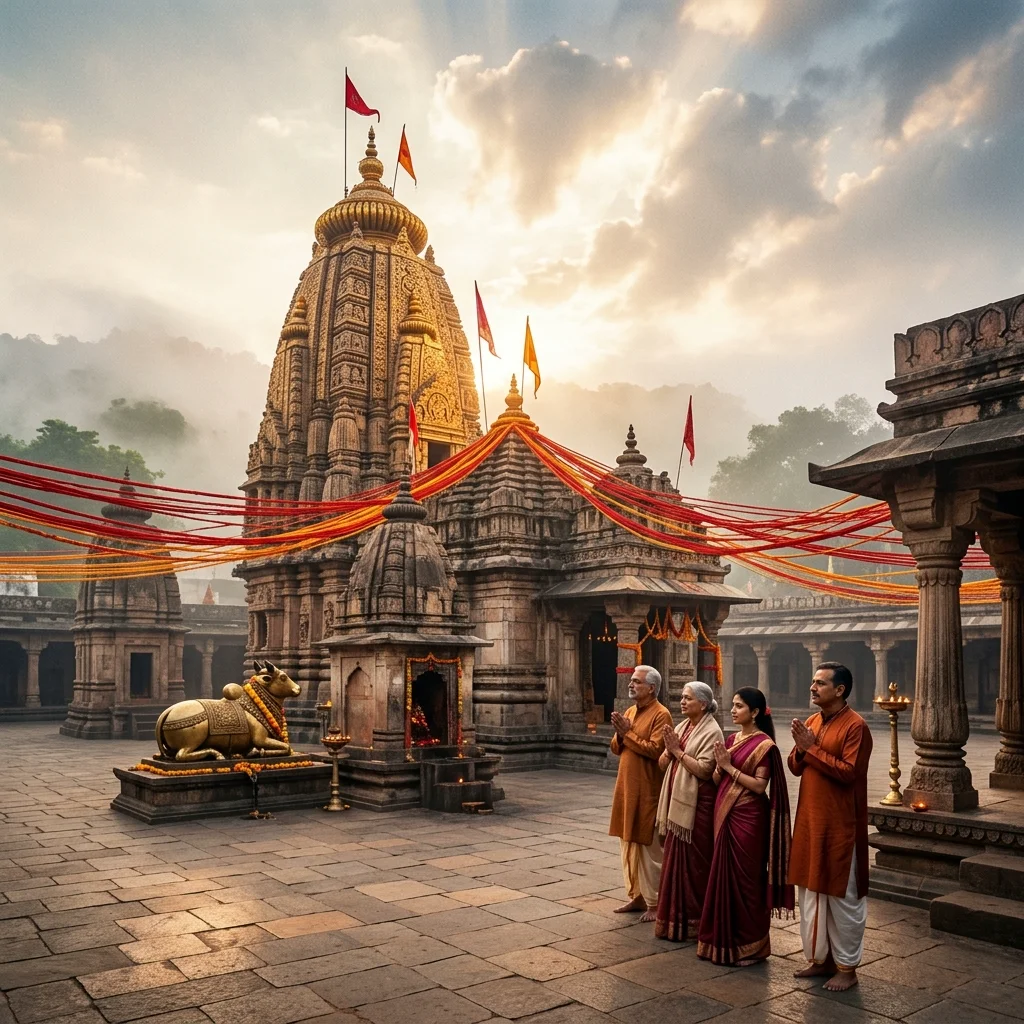
— The Abode of the Gods —
Deoghar
Where Shiva Resides and a Million Pilgrims Walk Each Monsoon
Best Time
October – March (Shravani Mela: Jul–Aug)
Recommended Stay
1–2 nights
Nearest Airport
Deoghar (DGH), 12 km / Patna (PAT), 280 km
Heritage Status
Hindu Jyotirlinga · Shakti Peetha
The Story
The Temple Where Shiva Himself Refused to Leave
“"In the lore of the Shiva Purana, the demon king Ravana carried the Jyotirlinga toward Lanka on the condition that he never set it down. When he was tricked into placing it on Deoghar's earth, the lingam took root — and has not moved in the millennia since. Pilgrims have followed it ever since."”
Deoghar — literally "the abode of the gods" — is one of the most spiritually charged towns in eastern India, and arguably the single most important Shaivite pilgrimage site between Varanasi and Puri. At its heart stands the Baidyanath Jyotirlinga Temple, one of the twelve sacred Jyotirlingas of Hindu tradition — the radiant pillars of light believed to be the most direct manifestations of Lord Shiva himself.
The legend is among the most beloved in Indian mythology. The demon king Ravana, a devout Shiva worshipper, performed extreme penance to win the Jyotirlinga and carry it to Lanka. Shiva granted the boon — on one condition: the lingam must never touch the ground during the journey. The gods, fearing the consequences of Ravana's growing power, conspired with the boy-deity Vishnu to trick him into setting the lingam down at Deoghar. Once placed, it took root. Ravana could not lift it again. The lingam has remained on that exact spot — by tradition, for thousands of years — and the temple complex grew around it.
What makes Deoghar architecturally and spiritually unusual is that the Baidyanath complex contains twenty-two temples clustered together, including a rare double-shrine arrangement where the Jyotirlinga is connected by a sacred thread (gathbandhan) to the shrine of Goddess Parvati opposite it — making this one of only a handful of sites in India considered both a Jyotirlinga and a Shakti Peetha simultaneously. For devotees, this convergence is profound: it is here that Shiva and Shakti are worshipped as inseparable, on the same axis, in the same breath.
Deoghar comes most alive during Shravani Mela — the month-long festival in July–August when over ten million pilgrims (the Kanwariyas, dressed in saffron) walk 108 kilometres barefoot from Sultanganj on the Ganga, carrying urns of holy river water on bamboo shoulder-poles, to pour over the Baidyanath lingam. It is among the largest pedestrian religious gatherings on earth — comparable in scale to the Hajj. Witnessing it as a respectful traveler (not participant) is unforgettable; for serious Shaivite devotees, walking even a symbolic portion of the route is a transformative act of faith.
Beyond the Jyotirlinga, Deoghar rewards the wider traveler. Nandan Pahar — Pleasure Hill — offers panoramic views of the temple town from a small Devi shrine at its summit. Tapovan, six kilometres away, is a forested hill where the sage Balananda Brahmachari is said to have performed long penance; today it shelters caves, ashrams, and small Shaivite hermitages worth visiting at dawn. The Naulakha Mandir, modeled on the Belur Math, is a striking modern temple built by a princess in mourning. Satsang Ashram, founded by Sri Sri Anukulchandra, draws lakhs of followers and offers a meditative counterpoint to the high-energy Jyotirlinga complex.
For HNI and Indian diaspora travelers, Deoghar is a deep-roots pilgrimage destination — less polished than Varanasi or Tirupati in tourist infrastructure, but spiritually unmatched for serious Shaivites. Roots & Rounds curates Deoghar journeys with hereditary priests of the Baidyanath temple who arrange off-crowd darshan hours (often pre-dawn or late evening), explain the elaborate puja sequence in English, and accompany guests through the labyrinth of the twenty-two-shrine complex. We pair this with a quiet evening at Tapovan, a private Rudrabhishek ceremony, and accommodation at the best heritage and modern properties the town offers.
Come to Deoghar not for spectacle, but for submission — the quiet kind, where Shiva is asked for nothing and granted everything in return.
A Day in the Life
The Rhythm of Deoghar
Pre-dawn pickup from hotel. Drive to the temple complex while the streets are still quiet.
A transcendent encounter designed to unveil the layers of history and spiritual depth that define this sacred topography.
Pre-dawn darshan at Baidyanath Jyotirlinga. Your hereditary-priest escort secures priority entry through the southern gate. The first abhishek of the day begins around 4:30 AM — water, milk, sandalwood paste, bilva leaves poured over the lingam in the proper Vedic sequence.
A transcendent encounter designed to unveil the layers of history and spiritual depth that define this sacred topography.
Walk through the twenty-two-shrine complex with English-language commentary. Visit the Parvati temple opposite, observing the sacred gathbandhan thread that connects them.
A transcendent encounter designed to unveil the layers of history and spiritual depth that define this sacred topography.
Breakfast at hotel — traditional kachori-sabzi, fresh hot jalebi, masala chai.
A transcendent encounter designed to unveil the layers of history and spiritual depth that define this sacred topography.
Drive to Tapovan (6 km). Forest walk with your guide; visit the caves of Sage Balananda Brahmachari. Optional brief sitting meditation in one of the cave shrines.
A transcendent encounter designed to unveil the layers of history and spiritual depth that define this sacred topography.
Lunch at hotel — sattvic Bihari-Bengali thali, banana-leaf service if preferred.
A transcendent encounter designed to unveil the layers of history and spiritual depth that define this sacred topography.
Private Rudrabhishek ceremony arranged in your name at a smaller sanctum within the complex, conducted by your hereditary priest. 90 minutes of full Vedic ritual with English explanation throughout.
A transcendent encounter designed to unveil the layers of history and spiritual depth that define this sacred topography.
Climb Nandan Pahar for sunset and panoramic views over the temple town.
A transcendent encounter designed to unveil the layers of history and spiritual depth that define this sacred topography.
Dinner at hotel. Quiet evening; early sleep recommended for early-morning departures.
A transcendent encounter designed to unveil the layers of history and spiritual depth that define this sacred topography.
Curated Experiences
What You'll Experience
Spiritual & Historical Walks
Pre-Dawn Darshan at Baidyanath Jyotirlinga
Stand before one of Shiva's twelve sacred pillars of light, before the crowds.
Spiritual & Historical Walks
Private Rudrabhishek Ceremony
A traditional Vedic ritual performed in your name by hereditary priests.
Spiritual & Historical Walks
Tapovan Forest Walk & Cave Visit at Dawn
The sage's hermitage, the silent caves, the forest waking.
Festival Immersions
Shravani Mela Viewing (Seasonal)
Witness ten million pilgrims walk — respectful, distant, profound.
Before You Go
Practical Information
Best Time to Visit
October – March for general visits; Shravani Mela (Jul–Aug) for the great pilgrimage spectacle; Maha Shivaratri (Feb/Mar) for the most spiritually intense single night. Avoid April – June (40°C+ heat); peak Shravani Mela days unless specifically traveling for it (extreme crowds)
Getting Here
Deoghar Airport (DGH) — 12 km / 25 min. Limited flights, mostly via Kolkata or Patna. Alternative: Patna (PAT) → 280 km / 6-hr drive or via Vande Bharat to Jasidih Station (8 km from town)
Recommended Stay
1–2 nights; 2 if including Tapovan and ashram visits
Where to Stay
Hotel Yashoda International, Le ROI Deoghar, Hotel Rajshree Heritage, or our boutique guesthouse close to the temple. Note: ultra-luxury options are limited; our Signature tier secures the best available
Sacred Etiquette
Strict dress code at Baidyanath — shoulders & knees covered; dhoti or pyjama-kurta recommended for men entering the inner sanctum; women in saree or salwar-kameez. No leather (belts, wallets) inside the sanctum
Photography
Strictly prohibited inside the Baidyanath inner sanctum and most active worship areas; permitted in outer complex
Mobility Notes
The temple complex involves steps and narrow corridors; during high-crowd periods, navigating is physically demanding. We arrange priority access through priest channels for senior travelers
Booking Note for Pujas
Rudrabhishek and special ceremonies must be booked 14–21 days in advance. During Shravani Mela, 60–90 days advance booking is essential for any special access
Festivals to Catch
Shravani Mela (Jul–Aug); Maha Shivaratri (Feb/Mar); Bhadra Purnima (Aug/Sep)
Languages You'll Hear
Hindi, Bengali, Santhali, Sanskrit (rituals), English (with our scholar-translators)
Cuisine
Sattvic Bengali-Bihari thali traditions; pilgrim-friendly vegetarian fare; avoid non-vegetarian food during your temple-day mornings out of respect
I had been to Varanasi, Rameswaram, Somnath, and Kedarnath. I did not expect Deoghar to be the most powerful of all of them — but it was. Standing at 4:45 AM in front of the Jyotirlinga as the first abhishek began, with our priest reciting in Sanskrit and quietly translating into English between mantras, I understood for the first time why my grandfather had wanted his ashes brought here. We did that the next morning.
— Vikram Iyer, Bangalore · Ancestral Shaivite Journey, November 2024
Begin Your Exploration
Ready to stand before the Jyotirlinga?
Whether you seek a single dawn darshan or a complete Shaivite ritual journey, our hereditary priests and scholar-guides will craft a pilgrimage that honours both your tradition and your time.